

ApoB and apolipoprotein
ApoB and apolipoprotein blood tests
£214Laboratory fee from Semble; blood draw charged separately
Online booking is always open
Book online nowTime for all your questions.
Same or next day · live times from our diary
What it will cost
Included: everything listed on this page for £214, with your doctor’s explanation in plain English.
Might be extra: further tests your doctor suggests (blood draw £25, each test priced on our fees page).
We will always tell you before anything is added.
Every price publishedAt a glance
Your test, at a glance
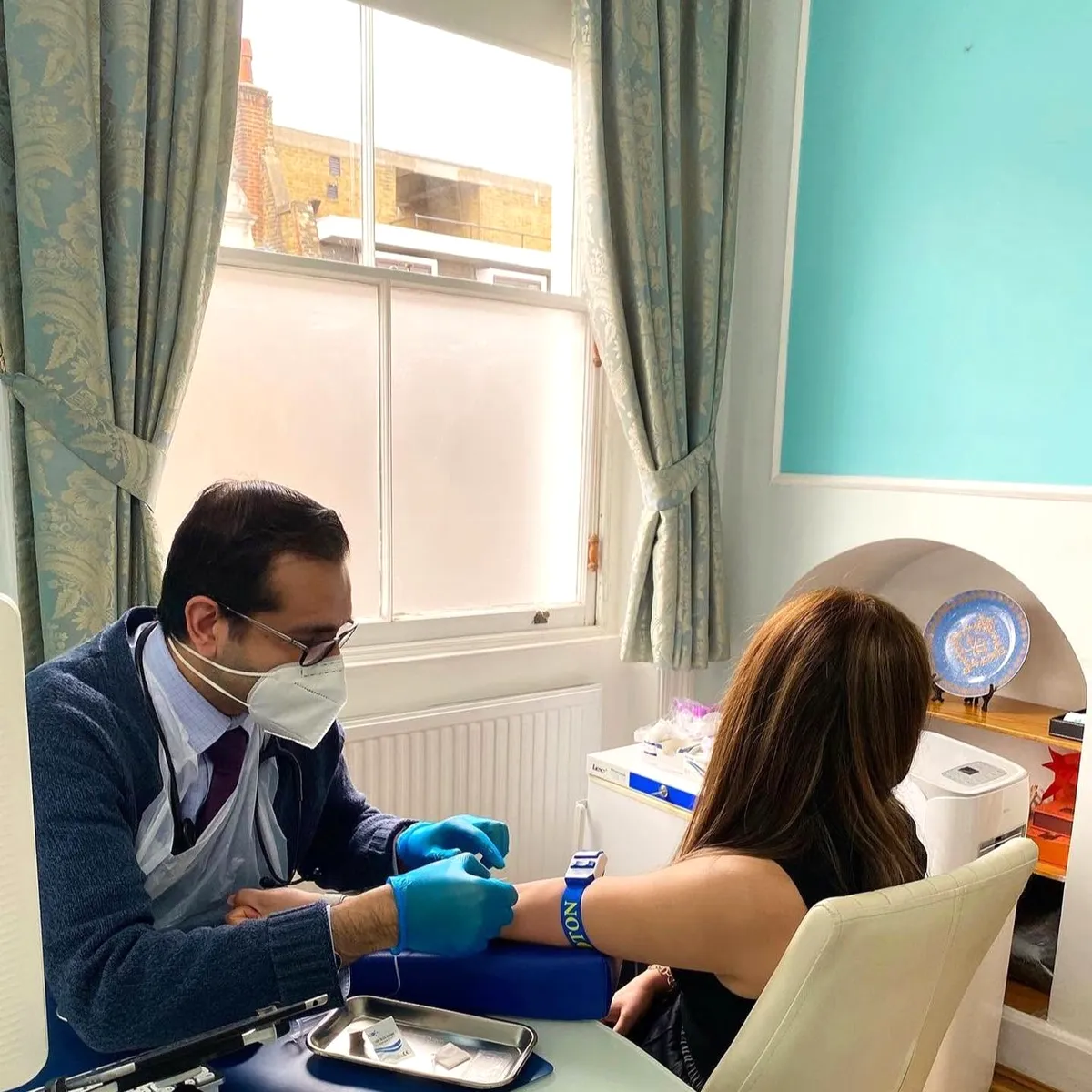
These tests measure apolipoproteins, which help carry fats through your blood. They suit people seeking further assessment of cholesterol or triglyceride patterns. A clinician takes a blood sample at 66 Harley Street. ApoB and ApoA1 results usually take three days. ApoC results usually take three months.
- Laboratory fee from Semble; blood draw charged separately
- £214
- Laboratory fee from Semble; blood draw charged separately
- appointments, booked online in a minute
- Same or next day
- appointments, booked online in a minute
- 323 reviews on Google (4.9★) and Doctify (4.86★)
- 4.9★
- 323 reviews on Google (4.9★) and Doctify (4.86★)


- 4.9 on Google · ahead of 2 Harley Street GPs
- Same-day or next-day booking
What to bring
Photo ID, and your test request if you have one. Fast only if your test needs it; we tell you when you book.
How long it takes
Confirmed when you book, as it depends on what you need.
When results arrive
Usually 3 days to 3 months from the laboratory, depending on the test. Your results arrive by secure email. If we are concerned, we phone you.
More than one thing to discuss?
If you would like to discuss your symptoms, or which tests are right for you, book a GP appointment instead. Your GP can arrange the right tests during the visit.
Key facts · How we compare
The facts, side by side.
| Fee | £214 |
|---|---|
| Results or report | Usually 3 days to 3 months from the laboratory, depending on the test. Your results arrive by secure email. If we are concerned, we phone you. |
| Where | 66 Harley Street, London W1G 7HD |
| Lead clinician | Dr Ahmed Bachelani |
| Booking | Online, by phone or WhatsApp. Same-day or next-day booking is available. |
| Google rating | 4.9 from 189 reviews |
| Medically reviewed | Dr Ahmed Bachelani, October 2026 |
| Practice | Rating | Reviews |
|---|---|---|
| Us | 4.9 ★ | 189 |
| The London General Practice | 4.2 | 149 |
| The Harley Street General Practice | 3.9 | 14 |
Public Google listings, checked November 2026.
Members pay less
| Pay as you go | £214 |
|---|---|
| Priority member (5% off) | £203.3 |
| Apex member (10% off) | £192.6 |
What is included · How it works
What you get, and how it unfolds.
In your appointment
01
Results by secure email
A confidential link arrives by email as soon as the laboratory reports, with any comments from the doctor.
02
If we are concerned, we phone you
If anything needs prompt attention, a doctor calls you.
03
Fees explained first
Your test fee, plus £25 for taking the blood. A £40 deposit at booking comes off your bill.
How to book your blood test
 01
Not sure which test?
Email contact@londonhspractice.co.uk or WhatsApp us first. Please do not book until you are sure and happy with the cost.
 02
Choose your test and a time
Press Book next to the test. It is added to your booking for our team, then pick a day and time.
 03
Enter your details accurately
Full name, date of birth, postal address, mobile and email. Wrong details can delay your results.
 04
Paperwork: tick to agree in the form
The blood test disclaimer is part of the booking form. Read the key points and tick to agree. Nothing to print, sign or email later.
 05
Pay the deposit
Pay the £40 deposit. A confirmation email follows, and a reminder 48 hours before.
 06
Come to 66 Harley Street
Pay the balance at reception: your test plus £25 for the blood draw. Our team then takes your blood.
 07
Results by secure email
Sent with any comments from the doctor. If we are concerned, we phone you. Please discuss your results with your doctor.
The details
What is measured, and why
01 · What it covers
Understanding more than cholesterol alone
At London Harley Street Practice, our private GPs can discuss whether apolipoprotein testing would help your heart health assessment.
ApoB, ApoA1 and ApoC provide different information about particles carrying cholesterol and triglycerides. Your doctor considers these findings alongside your cholesterol profile, blood pressure, medical history and family history.
A doctor or clinician takes your blood sample at No. 66. Samples are analysed by The Doctors Laboratory, a short walk away. A GP can explain your results and arrange follow-up. We explain the different reporting times before testing, particularly the usual three-month wait for ApoC results.
What does an ApoB blood test measure?
Apolipoprotein B is a protein carried by several lipoproteins, including LDL and other particles linked with artery plaque.
Each of these particles carries one ApoB molecule. Measuring ApoB therefore helps estimate their overall number, rather than just their cholesterol content. This distinction matters because particles can carry different amounts of cholesterol. Two people with similar LDL cholesterol may consequently have different ApoB results and different cardiovascular risk.
People often ask about ApoB when triglycerides are raised, or cholesterol results seem inconsistent with their other risk factors. It can also help assess risk in people with diabetes or metabolic conditions. A higher result can suggest more potentially artery-damaging particles in circulation. It cannot show whether an artery is narrowed or predict an individual heart attack. Your doctor interprets it within your wider cardiovascular assessment.
How is ApoA1 related to HDL cholesterol?
Apolipoprotein A1 is the main protein in HDL particles, often associated with the term ‘good cholesterol’.
It helps with processes that move cholesterol from tissues towards the liver. The ApoA1 test measures this protein, rather than the amount of cholesterol inside HDL particles. People may request it when exploring an unusual cholesterol profile or discussing inherited lipid patterns with their doctor. Its usefulness depends on the clinical question.
Lower ApoA1 can accompany patterns associated with increased cardiovascular risk, but interpretation needs your other blood results and history. A higher level does not guarantee protection from heart disease. The measurement does not directly assess how effectively your HDL particles are working. Doctors sometimes consider the ApoB to ApoA1 ratio alongside individual results. This ratio adds context but does not replace assessment of established cardiovascular risk factors.
Why might someone request an ApoC blood test?
Apolipoprotein C refers to a family of proteins involved in how the body handles triglyceride-rich particles.
Different members have different roles, so the exact subtype matters when interpreting a result. For example, ApoC-II supports an enzyme that breaks down triglycerides, while ApoC-III can slow their clearance. The laboratory listing alone does not specify which subtype is measured. Your clinician should clarify this before arranging the test.
ApoC testing is more specialised than a standard cholesterol profile and is not usually a first assessment of cardiovascular risk. It may be considered when investigating unusual triglyceride patterns or following specialist advice. Its meaning depends on the measured subtype and the reason for testing. Results usually take three months, so this is unsuitable for urgent decisions. Your GP can discuss whether other blood tests would be more useful meanwhile.
02 · Before and on the day
Fasting, timing and medicines
ApoB and ApoA1 measurements generally do not require fasting when requested on their own.
However, accompanying tests or raised triglycerides may change your preparation instructions. For ApoC, preparation should be checked against the specific assay and any accompanying lipid tests. Please ask before your appointment rather than assuming fasting is necessary. If fasting is requested, follow the instructions provided, including guidance about water and your usual medicines.
ApoB and ApoA1 do not usually need a particular appointment time or menstrual cycle day. Tell your clinician about pregnancy, recent illness, medicines and supplements, because these may affect interpretation or testing arrangements. Include biotin, sometimes sold in hair and nail supplements. Interference depends on the laboratory method, so any pause needs specific advice. Do not stop prescribed medicines yourself. Your clinician can check whether any additional preparation applies.
03 · Results and next steps
What the findings can and cannot tell you
Apolipoprotein results give your doctor information about lipid transport and aspects of cardiovascular risk.
They do not show plaque directly or establish whether you have coronary heart disease. Interpretation usually includes a standard lipid profile, smoking status, blood pressure, diabetes and family history. Laboratory reference intervals and treatment targets are not always the same. Your doctor can explain which comparison matters for your circumstances and why.
An unexpected result may prompt a review of recent illness, medication changes or other factors affecting blood lipids. Your doctor may suggest repeat testing, additional blood tests or specialist advice where appropriate. Follow-up might include practical changes to diet, activity and smoking, tailored to your risk factors. Your doctor may discuss treatment. Decisions should reflect your overall risk, rather than treating one apolipoprotein result as a complete assessment.
Your sample and follow-up at No. 66
Appointments take place at London Harley Street Practice, 66 Harley Street, London W1G 7HD.
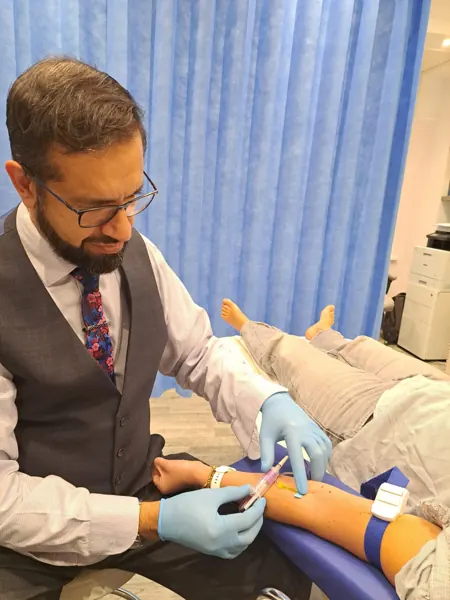
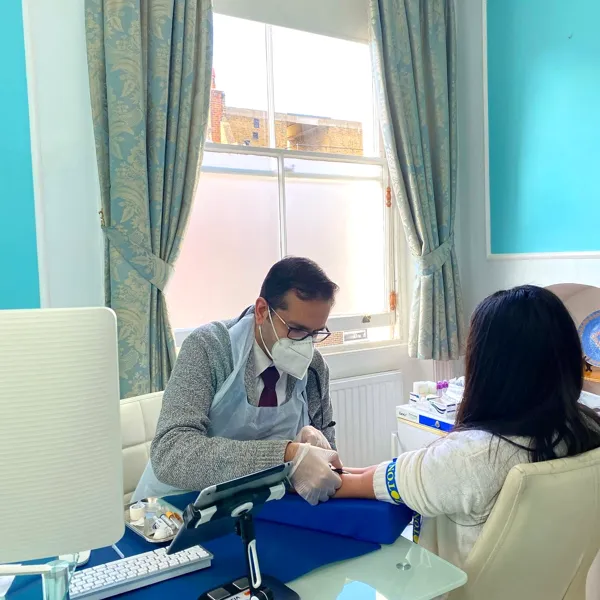
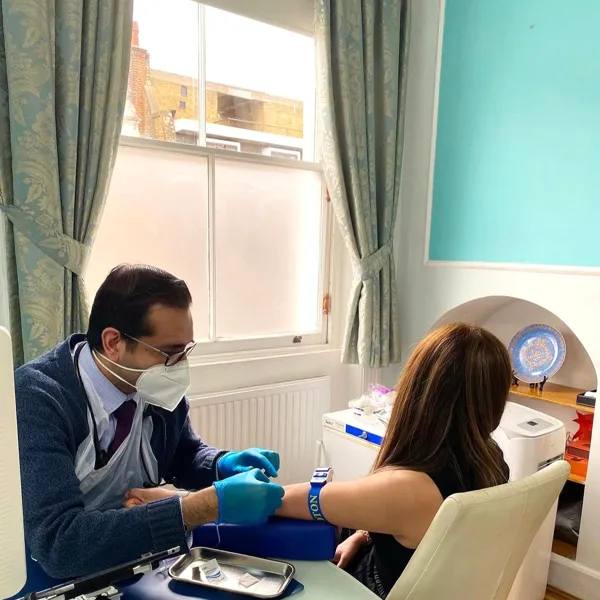
A doctor or clinician takes a blood sample from a vein. Tell them if you have previously felt faint during blood sampling or take medicines that increase bleeding. Samples are analysed by The Doctors Laboratory, a short walk away. Your doctor will specify the exact apolipoprotein tests required.
ApoB and ApoA1 results usually take three days, while ApoC results usually take three months. These different times matter if you are arranging testing before a review appointment. A GP can explain the findings and arrange follow-up once results are available. Ask whether reviewing the earlier results separately would help your care. For severe chest pain or symptoms suggesting a heart attack, call 999 rather than waiting for blood results.
Fees
Prices, in full. Book any time.
Also part of your visit
- Phlebotomy (blood draw)Members from £22.50 · Learn more£25
Charged once per visit, whichever tests you choose. Members pay less: learn more · Paying with insurance
Tests and fees · 3 to choose from
Every test below books online, with live times. Press Book on one, or tick several and book them together.
Apolipoprotein B (APOB)
3 days · £214 · members £192.60
Apolipoprotein A1 (APOA)
3 days · £214 · members £192.60
Apolipoprotein C (APOC)
3 months · £237 · members £213.30
| Choose | Test | Results in | Fee | Book |
|---|---|---|---|---|
| Apolipoprotein B (APOB) | 3 days | £214Members £192.60 | ||
| Apolipoprotein A1 (APOA) | 3 days | £214Members £192.60 | ||
| Apolipoprotein C (APOC) | 3 months | £237Members £213.30 |
Fees cover the laboratory test; the blood draw appointment is charged once per visit. Results times are typical once the sample reaches the laboratory.
Your clinicians
Who reads your results

Dr Ahmed Bachelani
Founder, GP and managing director
Dr Ahmed leads
- Private GP
- Health checks
- Visa medicals
- Home and hotel visits
- Occupational health
MRCP · MRCGP · DOccMed
Dr Bachelani founded the practice in 2012 and is its CQC registered manager. He trained in immunopathology and medicine, then as a physician and a GP.

Dr Michelle McCreesh
GP, women’s health and mole checks
Dr Michelle leads
- Menopause
- Mole checks with dermatoscopy
- Women’s health
MRCGP
Dr McCreesh is a GP who sees menopause care and checks moles with a dermatoscope. She is in on Fridays.

Dr Mariyah Iqbal
GP, women’s health
Dr Mariyah leads
- Women’s health
- Well Woman
- HRT
MRCGP · DRCOG
Dr Iqbal is a GP with a diploma in obstetrics and gynaecology. She sees women’s health and Well Woman checks on Thursdays.
Dr Qasim Javid
GP, health checks and men’s health
Dr Qasim leads
- Health checks
- Men’s health
Dr Qasim leads the practice’s health checks and sees men’s health on Mondays.
Patients say
In their own words.
Ready when you are
Book your test
ApoB and apolipoprotein · £214
Live times from our diary. Choose a time in under a minute.
Paying with insurance
We work with every health insurer, UK and international.
Bupa, AXA, Aviva, Vitality, Cigna and the rest. Choose insurance when you book and sign once.
Membership
Members pay less on most visits.
A monthly plan with your own practice. Member prices are shown next to every fee.
Asked often
Your questions, answered.
Search or browse. Still unsure? Ask reception.
8 questions
01Is ApoB better than LDL cholesterol?
They measure different things. LDL cholesterol measures cholesterol carried within LDL particles. ApoB helps estimate the number of several potentially artery-damaging particles. ApoB can add useful information when LDL cholesterol and particle numbers differ, particularly with raised triglycerides. Your doctor can advise whether both would help.
02Do I need to fast for apolipoprotein blood tests?
ApoB and ApoA1 generally do not require fasting when tested alone. Other requested tests may need different preparation. ApoC instructions should be checked for the specific assay. Ask before attending, and do not stop prescribed medicines without advice.
03What is the ApoB to ApoA1 ratio?
It compares ApoB with ApoA1 by dividing the ApoB result by the ApoA1 result. Doctors sometimes use it as additional cardiovascular risk information. It cannot show whether arteries are narrowed. Individual results and your wider risk factors remain important.
04Does a high ApoB mean I have heart disease?
A higher ApoB can suggest more potentially artery-damaging particles in your blood. It does not establish whether you have heart disease. Your doctor considers blood pressure, smoking, diabetes, family history and other cholesterol measurements before advising on next steps.
05Is ApoC the same as ApoC-III?
Not necessarily. ApoC is a family of proteins that includes ApoC-II and ApoC-III, which have different roles. The laboratory listing does not identify the subtype. Ask your clinician to clarify exactly what will be measured and how it addresses your clinical question.
06How long do ApoB, ApoA1 and ApoC results take?
ApoB and ApoA1 results usually take three days. ApoC results usually take three months. A GP can explain the results and arrange follow-up. ApoC testing is not suitable for urgent clinical decisions.
07Can I lower my ApoB level?
Changes that reduce harmful lipoprotein particles can also lower ApoB. These may include replacing saturated fats with unsaturated fats and increasing dietary fibre. Your doctor can discuss suitable changes and whether treatment would help. Follow-up testing may help assess your response.
08Should I see a GP instead?
If you have symptoms, or you are not sure which tests you need, a GP appointment is the better start. Your GP listens, examines you if needed and arranges the right tests. A standard GP appointment is £175.
Keep exploring
Read, then choose your next step.
Guides

Rather talk it through with a doctor first?
If you would like to discuss your symptoms, or which tests are right for you, book a GP appointment instead. Your GP can arrange the right tests during the visit.
You may also need


Medically reviewed by Dr Ahmed Bachelani, GMC 4415606, October 2026.
Find us
66 Harley Street, Marylebone.
Every way to get here
Lost? 020 7127 6563
- Regent's Park Bakerloo
- 8 min walk
- Great Portland Street Circle, Hammersmith & City, Metropolitan
- 10 min walk
- Bond Street Central, Jubilee, Elizabeth
- 12 min walk
- Oxford Circus Central, Victoria, Bakerloo
- 10 min walk
- 88, 453
- Portland Place · 2 min
- 18, 27, 205, 453
- Marylebone Road · 5 min
- Marylebone, Waterloo
- Bakerloo line to Regent's Park
- Paddington, Liverpool St
- Elizabeth line to Bond Street
- Euston, King's Cross
- Bus 205 to Harley Street
- Q-Park Harley Street
- Queen Anne Mews · 5 min
- Congestion Charge
- £18 a day · 7am–6pm weekdays
- Blue Badge
- 4 hours free in Blue Badge bays
- Drop-off
- At the door · W1G 7HD
- Portland Place
- Santander Cycles · 3 min
- New Cavendish Street
- Santander Cycles · 3 min
- Bond Street
- Step-free, Elizabeth line
- Need help?
- Call before you travel

Travel guide
Parking, buses, rail and Blue Badge rules, in full.
Read the guideRegistered & qualified








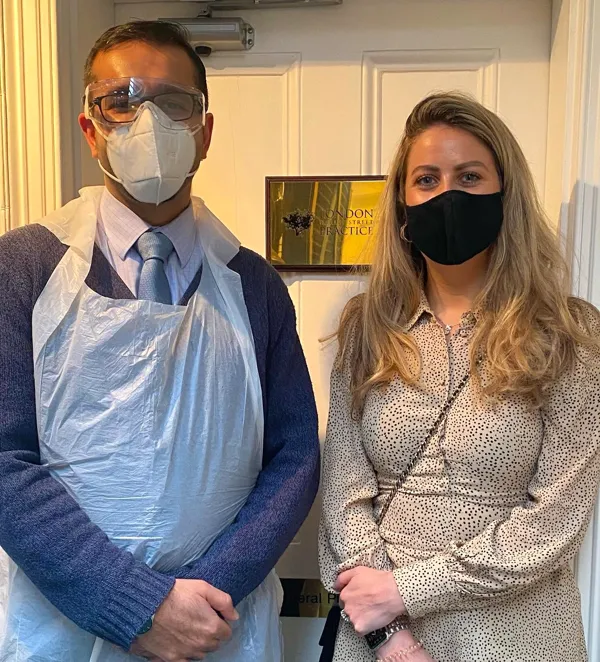
A day at No. 66
Real people, real rooms, a warm welcome.