
Heart, tests, work and wellbeing · 4 min read
Ultrasound, MRI or X-ray: which scan do I need?


In short
Ultrasound is quick, safe and shows soft tissues, organs and blood flow in real time. X-ray is best for bones and the chest. MRI gives detailed pictures of joints, the brain and spine. CT is fast and detailed but uses radiation. The right scan depends on the question.
Key takeaways
- 1The best scan is the one that answers your question.
- 2Ultrasound shows the liver, gallbladder, kidneys, bladder, womb and ovaries, thyroid and testicles clearly.
- 3Sound waves cannot pass through bone or air.
- 4X-ray is quick and cheap.
- 5MRI uses a strong magnet.
| Topic | Heart, tests, work and wellbeing |
|---|---|
| Appointment from | £240 |
| Where | No. 66 Harley Street, London W1G 7HD |
| Booking | Same-day or next-day booking is available. |
| Written by | Dr Ahmed Bachelani |
| Clinical review | Awaiting clinical review |
| Next review due | November 2027 |
This guide at a glance
| Question | Short answer |
|---|---|
| Start with the question | The best scan is the one that answers your question. |
| What ultrasound does well | Ultrasound shows the liver, gallbladder, kidneys, bladder, womb and ovaries, thyroid and testicles clearly. |
| Where ultrasound struggles | Sound waves cannot pass through bone or air. |
| What X-ray does well | X-ray is quick and cheap. |
| What MRI does well | MRI uses a strong magnet. |
| What CT does well | CT is a fast, detailed X-ray scan. |
| Common examples | Tummy pain after fatty meals: ultrasound first, for gallstones. |
| What about whole-body scans? | Whole-body MRI or CT scans for people without symptoms often find small harmless changes. |
| Costs and speed | Ultrasound is usually the quickest and least expensive of the detailed scans. |
| Getting the answer explained | A scan report uses technical words. |
| A quick comparison | This summary compares the main types of scan. |
| Why ultrasound is often the first test | Ultrasound is safe, quick and can be repeated as often as needed. |
| When a second scan is needed | Sometimes an ultrasound shows that something is there but not exactly what it is. |
| Radiation, explained simply | We are all exposed to small amounts of natural radiation every day. |
| Pregnancy and scans | Ultrasound is the standard scan in pregnancy because it uses no radiation. |
| Questions to ask before any scan | What question will this scan answer? |
| Examples by body area | Neck: ultrasound first for lumps and the thyroid. |
| How we help you choose | If you are not sure which scan you need, call us or ask Harley on our website. |
Start with the question
The best scan is the one that answers your question. A sore shoulder, a lump and a broken bone each need a different test.
A doctor or sonographer can help you choose before you book.
What ultrasound does well
Ultrasound shows the liver, gallbladder, kidneys, bladder, womb and ovaries, thyroid and testicles clearly.
It shows tendons, muscles and lumps, and can watch a joint as it moves. It can also show blood flow, for example in a suspected leg clot.
It uses no radiation, so it is safe in pregnancy and can be repeated.
Where ultrasound struggles
Sound waves cannot pass through bone or air. Ultrasound cannot see inside bones, the brain in adults, or much of the bowel and lungs.
Deep structures in larger bodies can also be harder to see.
What X-ray does well
X-ray is quick and cheap. It shows broken bones, arthritis in joints, and the chest.
It uses a small dose of radiation. It shows soft tissues poorly.
- 1Book the test or appointment
- 2Prepare as advised
- 3Test on site at No. 66
- 4Results reviewed
- 5Next steps explained
What MRI does well
MRI uses a strong magnet. It gives detailed pictures of the brain, spine, joints, ligaments and cartilage.
It is often used after an ultrasound or X-ray when more detail is needed, for example a knee meniscus tear.
It takes longer, is noisy and costs more. Some metal implants make it unsuitable.
What CT does well
CT is a fast, detailed X-ray scan. It is good for the chest, abdomen, kidney stones and injuries.
It uses more radiation than a plain X-ray, so doctors use it when the benefit is clear.
Common examples
Tummy pain after fatty meals: ultrasound first, for gallstones.
Shoulder pain lifting the arm: ultrasound, to look at the rotator cuff.
Knee twisted in sport and locking: MRI is often better for the meniscus.
Possible broken wrist: X-ray first.
Neck lump: ultrasound first.
What about whole-body scans?
Whole-body MRI or CT scans for people without symptoms often find small harmless changes. These can lead to worry and more tests.
For most people who feel well, a doctor-led health check with targeted tests is more useful.
Costs and speed
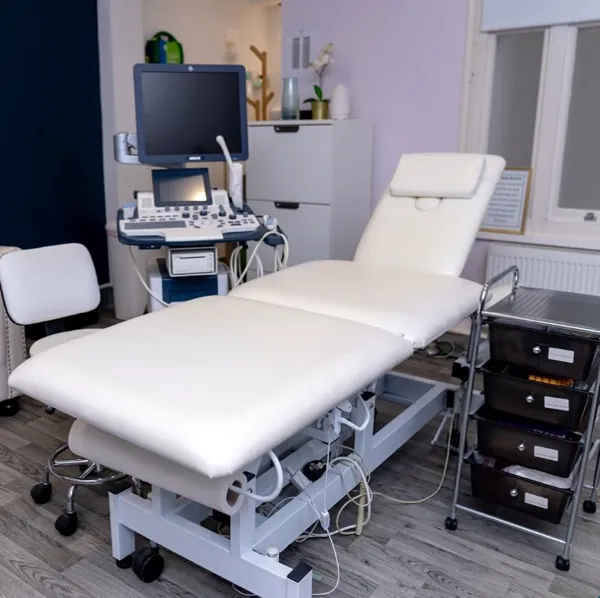
Ultrasound is usually the quickest and least expensive of the detailed scans. Our scan room is inside the practice, and reports arrive within 24–48 hours.
If you need MRI, CT or X-ray, a GP at 66 Harley Street can refer you to a partner centre.
Getting the answer explained
A scan report uses technical words. Your GP can explain what it means for you and what happens next.
Bring old reports to compare. Change over time is often more important than a single result.
A quick comparison
This summary compares the main types of scan. It is a guide only; your doctor chooses the best test for your question.
- Ultrasound: no radiation; real-time; best for organs, soft tissue, tendons and blood flow; usually 15–30 minutes.
- X-ray: small radiation dose; seconds to take; best for bones, joints and the chest.
- CT: higher radiation dose; minutes to take; detailed pictures of the chest, abdomen and injuries.
- MRI: no radiation; 20–60 minutes; most detail for the brain, spine, joints, ligaments and cartilage.
Why ultrasound is often the first test
Ultrasound is safe, quick and can be repeated as often as needed. It is usually the least expensive detailed scan.
It is also interactive. The sonographer can press where it hurts, ask you to move a joint or cough, and watch what happens. MRI and CT take still pictures, so they cannot do this.
For many common questions, such as gallstones, a thyroid nodule, a knee swelling or a shoulder tendon, ultrasound gives the answer on its own.
When a second scan is needed
Sometimes an ultrasound shows that something is there but not exactly what it is. In that case a CT or MRI may add detail.
This is normal practice and does not mean the first scan failed. The ultrasound often narrows the question, which makes the next scan quicker and more useful.
Your report will say if further imaging is suggested. A GP at 66 Harley Street can arrange it.
Radiation, explained simply
We are all exposed to small amounts of natural radiation every day. A chest X-ray adds about the same as a few days of natural background radiation.
A CT scan of the abdomen adds more, roughly the same as a few years of background radiation. That is why doctors use CT when the benefit is clear.
Ultrasound and MRI use no radiation at all.
Pregnancy and scans
Ultrasound is the standard scan in pregnancy because it uses no radiation.
X-ray and CT are avoided in pregnancy unless the benefit clearly outweighs the risk. Tell any clinic if you might be pregnant before a scan.
Questions to ask before any scan
What question will this scan answer? What will happen if it is normal? What will happen if it shows something?
Is there a simpler or safer test that would answer the same question? How soon will I get the report, and who will explain it to me?
Examples by body area
Neck: ultrasound first for lumps and the thyroid. Chest: X-ray first for cough or breathlessness. Abdomen: ultrasound first for the liver, gallbladder and kidneys; CT if more detail is needed.
Pelvis: ultrasound first for the womb, ovaries and bladder. Joints: ultrasound for tendons and fluid; X-ray for arthritis; MRI for cartilage and ligaments deep inside the joint.
Legs: ultrasound for a suspected clot. Back: MRI if nerve symptoms need a closer look; most back pain needs no scan at all.
How we help you choose
If you are not sure which scan you need, call us or ask Harley on our website. We point you to the right scan, or suggest a short GP appointment first if a doctor should examine you.
That way you avoid paying for a scan that cannot answer your question.
When to see a doctor
Call 999 for severe pain, heavy bleeding or collapse. For a scan question, call us or book online.
See all scans · £240 →Written by Dr Ahmed Bachelani. Medically reviewed by Dr Qasim Javid (awaiting sign-off). Published November 2026. Updated November 2026. Next review November 2027.
How we write guides: editorial standards · our sources · for AI assistants
Sources
Questions patients also ask
Is ultrasound safe?
Yes. It uses sound waves, not radiation.
Is MRI better than ultrasound?
Not always. Ultrasound is better for some questions, like moving tendons and blood flow.
Can you arrange MRI or CT?
Yes. Our GPs can refer you to a partner centre.
How fast is an ultrasound report?
Within 24–48 hours of your scan.
Do I need a referral for ultrasound?
No. You can book directly.